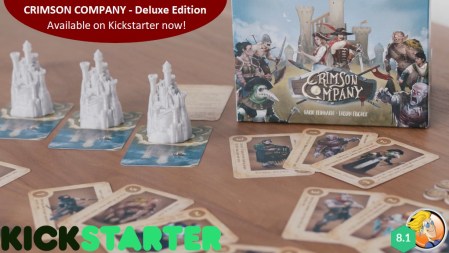
Nach der erfolgreichen Print-and-Play-Kampagne und einer von Kritikern wie Spielern sehr positiv aufgenommenen Erstauflage im letzten Jahr ist Crimson Company jetzt mit einer Deluxe-Variante wieder auf Kickstarter!
Wir freuen uns über jede Aufmerksamkeit, also zieht los und teilt die Kampagne mit eurer Filterblase! Vielen Dank!
“In the way that painting is the art form about looking, games are the art form about thinking and doing. […] They are opportunities to carve out a little space separate from the ordinary world, where we solve problems, we think and do, for its own sake.”
“Wer radikal umdenkt und die größte, ungenutzte Ressource entdeckt, nämlich Stil, Handwerk, Können, nur der kann sich der fortwährenden Peinlichkeit namens 85-Prozent-Spielspaß-Award und Spiel-XY-hat-Potenzial-Preview entziehen.”
“XCOM2 does a much better job at putting the player into tough but survivable combat situations. Since this is the core of its tactical combat, I view it as a design success and an improvement over XCOM2012.”
“We believe that viewing games within the space defined by the three axes of Agency, Abstraction, and Complexity, and specifying object interactions via a Component Interaction Matrix (or multiple hierarchical ones) will help demystify emergence and sharpen the designer’s ability to create it.”
“If the video game industry doesn’t want to regulate itself, it’s gonna keep drawing negative attention to itself. […] Aggressive monetization is about the only innovation many major publishers care about now.”
“It makes me recall that saying ‘If everyone is special, then nobody is’. Can’t you do the same for opinion statements? If every sentence needs one, can’t we agree that most of them don’t?”
“I think we’re moving towards a more complex idea of what games will be, and not just in strategy games. And this is a really positive thing, because I think our games have been just squarely too simple, which has forced us to rely on execution and bad forms of randomness to create variant outcomes.”
“Don’t feel the need to add in crappy skills just to boost the numbers. Some skill tree designers obviously believe that bigger is better. […] But if you ask me, a tightly pruned bush with a handful of truly interesting upgrades is often the best solution.”
“The design punishes the player for engaging the most stimulating and interesting kinds of dangerous combat situations. The design gives the player no reason to seek challenge, so the smart player studiously avoids it.”
“Something needs to shift in the way that companies in the US are treating their workers, not just in games, but definitely in games. […] We deserve a lot better than what happened at Telltale.”
“This is a classic case of what we on the channel here call a ‘Fee-to-pay’ game. […] There are lootboxes roped into this whole thing as well. This time they’re called reserves, because if you keep changing the name with each game you’ll fool people into thinking you don’t have lootboxes. […] And the fact these were smuggled in after launch only makes this shittier.”
“With each console cycle (and sometimes within the same one), we see the trends push developers to focus on a single design or style. […] When AAA games aren’t delivering, it’s up to the Indie space to deliver, and they most certainly have. Over the last eight years, some of the most touching, innovative, and unique games I’ve played have come from indie teams.”
“Despite their importance, however, it’s not unusual for the credits published with games to be inaccurate, incomplete, overly vague, or even (on rare occasions) downright misleading.”
Mal wieder ein kleiner Hinweis in eigener Sache: Hyperdrome, bei dessen Design ich den ein oder anderen Finger im Spiel hatte, ist ab sofort für iOS und Android verfügbar. Es handelt sich um ein 1-gegen-1-Rennspiel mit einem Twist – denn statt der direkten Steuerung eines Autos, dreht sich hier alles um das Auslösen taktischer Fähigkeiten.
“In games today, we put a huge emphasis on winning. We’ve moved it from being the goal of most games to the raison d’être of most games. […] Losing isn’t actually a bad thing. It’s often how we improve. […] If you’re not playing for the gameplay, the hook you’re playing for is as much of an illusion as any free-to-play treadmill or MMO grind.”
“You really can tell the difference between a game without micro-transactions and a game full of the bastards. Because one’s designed to encourage you to play it and the other […] goes against what a video game is because it doesn’t want to be played.”
“Screwing up causes you to dynamically shift your goal and do something different for a while. Awesome stories can occur when things go horribly wrong. And risky play is far more meaningful if you can’t just rewind and try again. But it can’t be up to the player to enforce this pure way of thinking. […] Given the opportunity, players will optimize the fun out of the game.”
“Die Erzählung in Spider-Man wird vorangetrieben durch Zwischensequenzen. “Filmisch” nennen Kritiker sie gern und erwähnen sie lobend. Doch was sind diese filmischen Sequenzen anderes, als die Verbannung der Spieler in die Passivität?”
“There were two predominant flavors of behavior. One was the use of sexual references and gestures by straight men toward other straight men, and the other was the sexist and inappropriate language about women. […] The head of Communications said that we were edgy, and that if we as Riot started chipping away those edges, we would become shapeless and bland, like EA or Blizzard. […] I concluded that I was not going to be able to effectively impact the issues with the culture at Riot, and my first significant attempt at raising concerns had put my job in jeopardy.”
“We’ve arrived at the worst it can get because you can’t sell less than zero. An experienced game designer with multiple shipped titles and a moderately sized following shouting into the void and getting no response whatsoever… I guess that’s the new normal, but something about that doesn’t seem normal to me at all.”
“It should be no surprise The Division 2 will feature a division of content as per Ubisoft tradition, because we’re expected to believe that a healthy industry is one where its leading companies can’t simply make products and then make money selling those products. […] If you need to do what Ubisoft is doing, the industry is fucked.”
“It’s hard to connect with the events on screen when we’re juggling several roles, one of those being a camera man wrestling against subpar equipment. […] Combat systems are complicated […] but generally speaking two major priorities should be clarity and consistency. […] The terrain is more concerned with looking nice than providing a clear battlefield for you to work with. […] Every combat system has flaws, but the ones in God of War are so pervasive they leave little left to be enjoyed.”
“Outside of combat the experience falls down in numerous other ways: Huge chunks of time are occupied by the sort of walkie-talkie sequences you’d find in Uncharted or The Last of Us. […] As it is now you’d have to be insane to replay it on a regular basis because you’d be forced into the same lengthy dialogue sequences every time.”
“Interacting with inventory and RPG mechanics costs time, which should pay off by enhancing the underlying gameplay in some way. […] But many games get away with tacking them on regardless because seeing the numbers go up is a shortcut to your brains pleasure centers. Combat systems that are good for their own sake don’t need leveling systems, in fact they’re better off without them.”
“Everything [God of War] does is better represented elsewhere. […] My problem isn’t so much with the developers of God of War, I’m sure they tried their hardest to make the best of what is fundamentally a bad situation. […] Games are more like films than they ever have been, not just because they shoehorn in shaky cams and other filmic techniques but because the business itself now mirrors the Hollywood machine: Budgets have gotten so big that games have to cram in a bunch of extraneous tickbox features or compromise on their vision to recoup costs.”
“If your game is too familiar, it’ll be boring and obvious. If it’s too novel, it’ll be weird and difficult to parse. […] Stylish, constrained art is always a thousand times more evocative than ‘my best stab at AAA’. […] I firmly believe that the best games are created by a combination of generalised grand-scale systems-oriented thinking, and microscopic nit-picking pedantic perfectionism. […] A very large proportion of any success you have will be entirely down to luck. You need to be conscious of this, embrace it and take it to heart.”
Die Spielergemeinde atmet auf. Endlich ist er da. Der große Reveal zu Cyberpunk 2077, dem neuesten Streich der Witcher-Macher. Schon in der ersten Sekunde wird klar: Hier geht es total erwachsen zu! “May contain content inappropriate for children”. Uiuiui! Erfahrene Musik-Käufer aus den 90ern wissen schon, dass der gefährlich klingende Spruch auf weiß-schwarzem Hintergrund letztlich eher “Jugendliche greifen besonders gerne zu!” bedeutet, statt eine wirksame Warnung für Erziehungsberechtigte darzustellen. Aber eins muss man CD Projekt lassen: Diese Message ziehen sie in den folgenden fast 50 Minuten absolut konsequent durch!
“Riot is just one company, but two dozen current and former employees have personally experienced or witnessed how its culture and structure—ones shared across the ranks of gaming, infosec, hardware, software, and digital marketplace companies and tech giants—disadvantaged women.”
“Respecting the player’s time is keeping them in control as to how long they want to play a game for. Essentially the player should never be “punished” for having real-life commitments. […] Having elements that force the player to play the game or continue playing to avoid a penalty are not examples of good design. […] One of the big issues when we talk about F2P games and heavily monetized titles is the very fact that they are not designed around the player’s experience, but to get as much money from them as possible. These games feature weighted elements such as gacha, loot-boxes, energy systems, “timed sales,” and more.”
“Those problems will be present no matter how you choose to spectate, and result in the same fatal flaw that’s sown by the chaotic nature of Plunkbat: it’s not tense enough to work as an esport. Not consistently. […] A battle royale structure can generate uniquely compelling moments for spectators, but only if they’re willing to sit through tedium and confusion.”
“To truly live is to be challenged and to change […] It’s one of the reasons that games are important. Games are a safe place to learn about the world, its systems, and ourselves. They let us practice at being human, whatever we interpret that to mean. They change us, shape us, hopefully for the better. […] If the game is only fun when you’re doing what comes naturally, it’s not very much of a game.”
“Aber bis die Mehrheit der deutschen Feuilletonisten begreift, dass sie seit mindestens 1993 (DOOM! Igitt!!!) die wirkmächtigste, am weitesten verbreitete und innovativste Kunstform des Planeten weitgehend ignorieren, werden noch eine Menge Ringzyklen den Bayreuther Hügel hinabgeschmettert werden.”
Ausnahmsweise etwas Werbung: Nach einer erfolgreichen Kickstarter-Kampagne zur Print-and-Play-Version kann die Erstauflage des von Dario Reinhardt und mir designten Kartenspiels Crimson Companyab sofort vorbestellt werden!
Im September werden wir professionell produzierte Spielepackungen in den Händen halten und verschicken können.
Mehr zur Spielidee und den Game-Design-Hintergründen demnächst an dieser Stelle!


 Posted by Fabian Fischer



 Ludokultur